



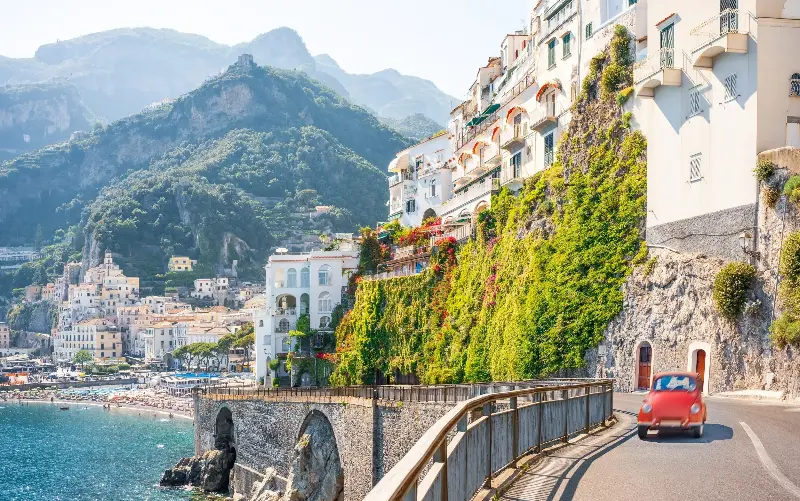
The Sorrentine peninsula pushes out into the Tyrrhenian sea like a gnarled finger, its southern shores blessed by some of the most spectacular coastal scenery in the world. Linking the towns is the SS163, the legendary Amalfi Coast Drive, a 10-mile, two-lane road that weaves and dips torturously up and down gorges, clinging to the cliff face from Positano to Amalfi. The background is lemon and olives groves, picture-perfect whitewashed villages and the ever-present shimmering blue sea.
This itinerary focuses on the principal stretch of the SS163, but the corniche road continues no-less dramatically all the way to Vietri-sul-Mare and tends to attract fewer crowds in this eastern stretch.
A word of warning; the road is notoriously difficult to navigate, mainly for the sheer volume of traffic. In high season (May to September), you are likely to find yourself – at best – crawling along at a snail’s pace, bumper-to-bumper behind scores of tourist buses. So either move around by sea or avoid these months; April and October are good times to visit.
In this guide:
How to spend your weekend
Day one: morning
Start your tour of the coast in Positano, the most famous of the Amalfi Coast towns, a tumble of pastel-hued houses clinging to an almost sheer cliff face. The best way to arrive is by sea, but if you are driving, park at the top of the town and walk down to Piazza dei Mulini from where steep, narrow (and tourist-clogged) Via dei Mulini descends towards the beach.
La Zagara is a good stop-off for coffee and delicious pastries and cakes. Further on is the elegant, 18th-century Palazzo Murat, once home to Giochino Murat, King of Naples, and now a very lovely hotel. Down the hill lies the church of Santa Maria Assunta and the entrance to the Museo Archeologico Romano, the recently discovered remains of a Roman villa.
The grey pebble beach of Spiaggia Grande is a good spot for a dip; you can hire a sun bed and umbrella from one of the lidos, or claim a patch of the free beach in the middle. Alternatively, a footpath leads to around the point to the less-crowded local’s beach of Il Fornillo, where the Pupetto hotel and beach bar will serve you an ice cold beer. Take the stepped path up the hill behind the hotel to see another side of Positano; here you’ll find a quiet neighbourhood where locals outnumber tourists.
The tiny village of Montepertuso towers above Positano (either drive up or catch the SITA bus) and is a cool, quiet escape from the crowds. Book a table at Donna Rosa for ravioli stuffed with local artichokes and lamb cutlets flavoured with wild rosemary.
Afternoon
Bolstered by lunch (and not too much wine), head to the even tinier village of Nocelle; the SITA bus will take you almost there. From the car park, access to the clutch of rustic houses is via some 100 steps, but once you arrive, the views are breathtaking.
Nocelle is the starting point for the “Sentiero degli Dei”, the Costiera’s most celebrated walk. The path meanders along the pinnacle of the mountains with, at times, sheer drops on either side. Finishing in Bomerano, the whole thing will take the best part of a day, but you can tackle just a short section. It is essential to carry water, a sun hat, sunblock and a camera to capture the extraordinary views.
Back in Nocelle, you can have a cool drink and a piece of homemade cake at Bar-Ristorante Santa Croce in the centre of the village.
Late
You have earned a slap-up evening out, so slip into some kind of casual-chic linen and cashmere combo and head for Aldo’s Bar at hotel Le Sirenuse for champagne, oysters and magnificent views.
You could move onto dinner at La Sponda, the hotel’s romantic candlelit restaurant, or walk up the road to the much more affordable Da Bruno for spaghetti alle vongole. For more suggestions of the best restaurants in the area, see our guide.
Round the evening off dancing in a sea cave at Music on the Rocks, a nightclub founded in the 1970s, on Positano’s Spiaggia Grande.
Day two: morning
There is a lot of ground to cover today, so try and get an early start; the going on the SS163 can be maddeningly slow. From Positano, a few twists and turns in the road to the east lead to the sprawling, low-key village of Praiano.
Bar Sole on the main street is the modest social hub of the village and they make a decent cappuccino. Ceramics whizz Paolo Sandulli has a studio on a quiet backstreet in the upper part of the town and welcomes visitors. Or you can pop into the workshop of luthiers Pasquale Scala and his son Leonardo who craft exquisite guitars, mandolins, lutes and other plucked string instruments.
Just along the coast is the tiny, picturesque fishing hamlet of Marina di Praia, a clutch of cottages, a couple of restaurants and a few boats pulled up on a tiny beach squeezed between walls of towering rock. From here you can rent a boat, either with or without a skipper, and spend a dreamy hour puttering along the coast towards Amalfi.
Pull up at waterside Ippocampo at Conca dei Marini for a seafood feast; it’s only accessible by sea or hundreds of steep steps. Alternatively, back at Marina di Praia, Armandino’s, a modest quayside trattoria, offers pasta with clams and grilled swordfish.
Afternoon
Continuing east, past the towering viaduct that crosses the Vallone di Furore, lies the Emerald Grotto, a popular tourist attraction named after the intense blue-green light that filters into the cave; access is via a lift on the main road.
The coast road winds past Amalfi and Atrani before reaching the turn-off for Ravello, a ravishing little town with an other-worldly atmosphere perched on a bluff more than a thousand feet above the gulf of Salerno. After a refreshing iced tea or gelato at one of the bars in the square, pop into the 11th-century Duomo to admire the two magnificent pulpits.
Nearby Villa Rufolo has a Moorish cloister and gardens that inspired Wagner for the second act of Parsifal in 1880. But the jewel in the crown is Villa Cimbrone with its grandiose gardens overlooking the sea; the Terrace of the Infinity is a particularly photograph-worthy spot. The Bloomsbury set hung out in the villa in the 1920s; today it is a luxury hotel where you can call in for a very civilised aperitivo or even an elegant dinner at the Michelin-starred Flauto di Pan.
Alternatively, head back down to Amalfi in time to visit the great Arab-Norman Duomo di Sant’Andrea and to stock up on traditional bambagina paper at the Scuderia del Duca and lemon and almond biscuits at historic Pasticceria Pansa.
Late
Once a glorious maritime republic of some 70,000 residents, Amalfi can feel oppressively crowded during the day, but come evening, many visitors leave. Bag a table at one of the bars in piazza Duomo, order a Campari spritz and settle down for some people watching before heading to the upper part of the town for dinner at Trattoria dei Cartari, a friendly little place serving authentic local dishes such as paccheri pasta with monkfish and prawns.
In keeping with this evening’s low profile entertainment, wander round the headland to charming Atrani and La Risacca in pretty piazza Umberto I for a nightcap; it’s a delightful spot in which to soak up a bit of local life. For more suggestions of the best nightlife in the area, see our guide.
When to go
This short stretch of coastline is packed from Easter until late October. July and August (Italian holiday time) are the hottest, most crowded months; the best times to visit are early spring and late autumn although even then you can’t expect to find the place empty.
In spring, the air is clear and fresh, the colours bright and the hillsides are carpeted with wild flowers. In late autumn, the sea is still warm enough to swim and the whole place seems to mellow in anticipation of the end of the season. Many hotels and restaurants close for the winter, but it is a wonderful time to come if you enjoy nature and the quiet life.
Where to stay
Luxury living
Often included in “World’s Best” lists and frequented by such stars as George Clooney and Julia Roberts, the legendary and oh-so-glam Il San Pietro di Positano lives up to its reputation. But the luxuriousness and spectacular setting belie what is, at the heart, a family operation, so the five-star service comes with a smile. Don’t miss restaurant Zass, where dishes such as lemon tagliatelle with lobster and fennel use fresh produce from the hotel’s 10,000 square-metre kitchen garden.
Boutique beauty
Until recently, Casa Buonocore was the home of a family who now run it with great dedication and style. The location is excellent and compared to Positano’s often outrageous prices, it is pretty good value too. Eight beautiful rooms of wildly varying sizes are all meticulously furnished with lots of attention to detail – one even has a huge panoramic terrace with views over the town and sea. Breakfast is the only meal on offer, but it’s outstanding (homemade cakes and pastries, eggs made to order, organic jams and yogurts) and changes daily.
Budget bolthole
For peace, verdant nature, and a taste of Italian family-style hospitality, look no further than La Valle delle Ferriere, a little b&b set on a footpath around a 15-minute walk from Amalfi’s town centre. It’s a heart-warming place with beautiful views (though the climb up to it will make your pulse race). With just three rooms and one apartment (done out in simple Amalfi Coast style), the atmosphere is quiet, intimate, and charmingly homely.
What to bring home
Vietri sul Mare has been famous for its production of majolica ceramics since the 11th century. I always head straight for the Solimene factory to peruse typically colourful homeware (you will recognise the naïf animal designs); the warehouse is stuffed with seconds at bargain prices and so is my kitchen in Florence. No room in your luggage? They will ship all over the world.
Derived from the Roman sauce “garum”, colatura di alici is an extract of anchovies used as a condiment on pasta and other dishes. Cetara is known for its anchovy fishing and the highly prized colatura is a by-product; all of the delis on the main street sell it, but some of the best can be sourced at Cetarii down by the harbour.
Know before you go
Getting there
The Amalfi Coast is not the most accessible of places and the re-vamped Salerno-Costa d’Amalfi airport seems to be handling fewer routes than were originally slated. You can fly directly from Stansted with Ryanair and the airport serves a number of European destinations as well as domestic flights. Journey time into the city centre is around 20 minutes by taxi. If you are moving on to the Costiera, there are regular ferry services to Amalfi (40 minutes) and Positano (one hour) from Salerno’s tourist port.
Naples Capodichino airport has more choice of inter-European flights while Rome Fiumicino handles intercontinental routes. From Naples you can arrange a private transfer or take the Campania Express train (mid-March until mid-October) to Sorrento and then a bus to the coast. Off-season, you are left to the mercy of the much slower Circumvesuviana service. There is also a regular ferry service from Naples to Sorrento which is faster than going by road.
Essential information
- Once in the area, the SITA bus company provides an efficient, cheap service up and down the coast and to outlying towns and there are plenty of taxis.
- The local dress code for churches dictates that shoulders and midriffs should be covered (a scarf or shawl will do) and skirts should not be too short.
- Italians always say hello and goodbye in social situations and when entering or leaving a bar or a shop; a simple buon giorno in the morning or buona sera in the evening is good, plus arriverderci when you leave. When you are introduced to an Italian, it is normal to shake hands.
- In Italy, generous tips are not expected in restaurants or by taxi drivers although you can always show your appreciation after a meal by rounding the bill up a few euros.
The basics
- Currency: Euro
- Telephone code: 00 39 081 (anywhere in the province of Naples); 00 39 089 (anywhere in the province of Salerno)
- Time difference: UTC +1 hour
- Flight time (from London): Approximately 2.5 hours
Essential contacts
- British Embassy: 00 39 06 4220 0001; gov.uk; Via Venti Settembre, 80A, 00187 Roma. Open 9am to 5pm, Mon-Fri. Visits by appointment only
- Police: Dial 11
- Ambulance: Dial 118
Tourist offices
- Positano: aziendaturismopositano.it
- Ravello: ravellotime.it
- Amalfi: visitamalfi.info