



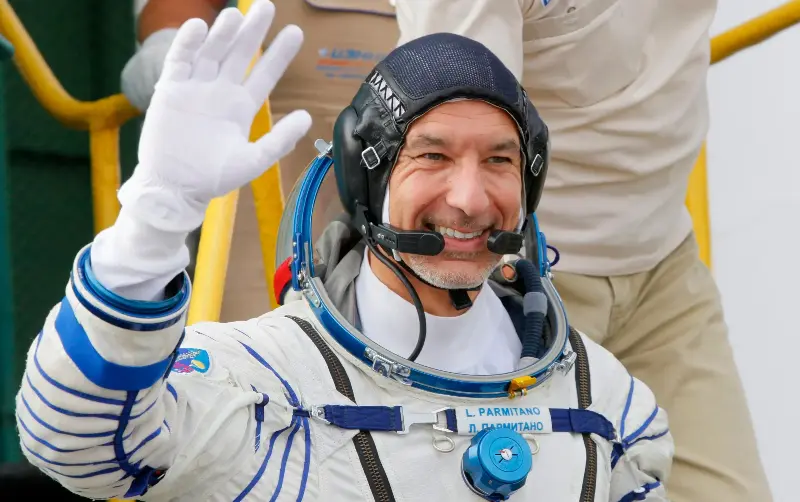
An Italian astronaut who almost drowned in space is the first European to be selected for Nasa’s Artemis Moon mission.
Col Luca Parmitano, 49, a former test pilot for the Italian air force, will join three others for the Artemis III flight to test the landing craft that will take humans back to the Moon.
He is the first European Space Agency (ESA) astronaut to be included in an Artemis mission, which is aiming to land on the lunar surface in 2028.
The other astronauts who will fly on the mission are Nasa’s Andre Douglas, Frank Rubio and Randy Bresnik.
Col Parmitano said: “I am honoured by the role that I have been given. I am very humbled by the task in front of us. I am very grateful.”
Thanking his family, he added: “I wouldn’t be going anywhere without fuel, and you are the energy that feeds my soul.”
Commander Bresnik said: “It is an honour and a blessing to be part of such a stellar crew.”
In 2013, Col Parmitano became the first Italian to carry out a spacewalk from the International Space Station (ISS), but the assignment was cut short when he felt water creeping over his face and realised he was just minutes from drowning.
“I couldn’t breathe through my nose,” he said at the time, describing it as feeling like being a “goldfish inside a fish bowl”.
“When the water reached my face, it spread over my nose and up into my nostrils in an instant,” he said. “I couldn’t even be sure that the next time I breathed I would fill my lungs with air and not liquid.”
Unable to see, Col Parmitano was forced to use his safety cable as a guide to quickly float back to the airlock. An investigation later found that the water from the cooling system had leaked into the helmet.
Col Parmitano returned to the ISS in 2018, becoming the first Italian commander of the space station and working alongside Christina Koch, from the recent Artemis II mission.
Speaking about Col Parmitano, Josef Aschbacher, the director general of ESA, said: “He has been tested during a spacewalk early in his career.
“His helmet began to fill with water, a dangerous situation by any standard, and he handled it with calm and clarity and brought himself back safely.
“I am sure he brings a touch of Italian ease to the cockpit. We could not have wished for a better pilot.”
Inside Artemis III
On Tuesday, Nasa set out new details of the Artemis III mission.
Blue Origin’s Blue Moon lander will launch first and “loiter” in space awaiting the arrival of the crew in the Orion spacecraft, which will launch on the space launch system from Kennedy Space Centre.
Orion will then dock with Blue Moon and remain locked together for two days, conducting tests and demonstrations before undocking.
SpaceX’s Starship will then launch and meet up with Orion, and connect for one day, before the crew returns home, splashing down in the Pacific. The mission will last around two weeks.
Jared Isaacman, the administrator at Nasa, said: “We are returning to the Moon, a grand adventure back to the lunar surface, to build a Moon base and do so for all of its scientific and economic potential and to master the skills for where we will inevitably go next.
“Over the next year, the astronauts will train for their mission, ensure the lessons learned from the prior crew are implemented, and assist in the development of the landers and operational procedures that will be necessary for their colleagues on future Artemis missions.
“This seems like the beginning of the future that we imagined as children. This seems like the very beginning of Earth’s first Starfleet.”
Mr Isaacman said that the “wet dress rehearsal” for the mission – which tests all the systems short of launching – will take place before the end of the year.
The Artemis III mission follows on from Artemis II, which sent four astronauts around the Moon in the Orion spacecraft in April.
The third Artemis mission was originally scheduled to land on the Moon, but in February Nasa announced that it would instead practice docking Orion with the landing craft, which will take the astronauts to the surface.
Astronauts will carry out rendezvous and manoeuvring tests in low earth orbit, as well as checking life support systems, communications, propulsion, and trying out the new extravehicular activity astronaut suits for spacewalks.
Artemis III could involve both Elon Musk’s SpaceX Starship human landing system (HSL) and Jeff Bezos’s Blue Origin Blue Moon lander, which are both vying to be selected for the first lunar touchdown since 1972.
Nasa has said that the two could be in space at the same time.
As well as humans, the landers are required to ferry cargo to the Moon for the building of a base, which Nasa wants in place by the early 2030s.
However, both landers are currently unable to fly following a spate of recent problems.
Last week, Blue Origin’s New Glenn rocket exploded, just a week after SpaceX’s booster rocket crashed into the sea.
SpaceX’s Starship has been grounded by the Federal Aviation Administration after its super heavy booster rocket went off course and plunged into the Gulf of Mexico, prompting an investigation.
It means that neither of the launch systems that will take humans back to the Moon is currently operational.
Last week Mr Isaacman sent an email to staff following the New Glenn explosion. He said: “I am sure it is not lost on anyone how this situation could potentially impact our Artemis and Moon base ambitions.
“I also know that most of you chose careers at Nasa because you thrive in challenging circumstances. This moment is challenging, but it is far from insurmountable.
“We have immense talent across the agency, the healthiest launch industry in the history of America’s space program, strong commercial partners and the resources and the whole of government support to overcome nearly any obstacle.”
The Moon landers that will be tested on Artemis III are very different from each other.
Starship is a massive, fully reusable, methane and oxygen-fuelled lander, which lands vertically and ferries the astronauts to the ground using a space elevator.
It is launched on a SpaceX super heavy booster rocket and will be refuelled in space before journeying to the Moon.
Although it will be carrying just four crew members to the lunar surface for Artemis, it could potentially carry up to 100 astronauts on future Moon or Mars missions, as well as up to 200 tons of payload capacity.
In contrast, Blue Moon looks like a larger, elongated version of the Apollo lander. It is fuelled by liquid hydrogen and oxygen and is launched on a Blue Origin New Glenn rocket. It can carry four astronauts and about 30 tons of cargo.