



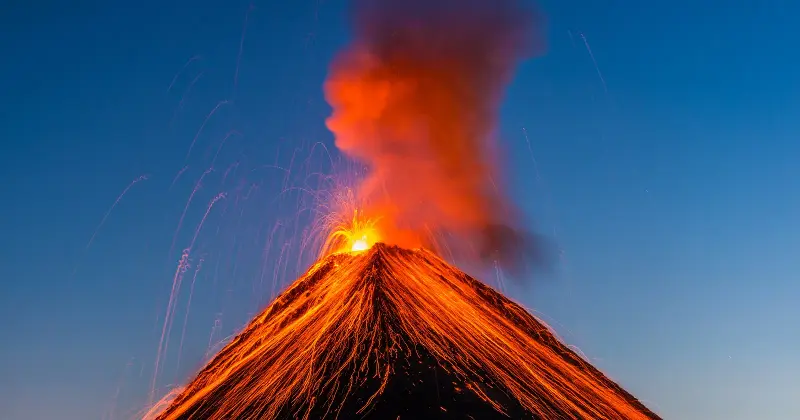
At 10:02 in the morning of 27 August 1883, the volcanic island of Krakatoa in the Sunda Strait between Java and Sumatra produced an explosion of almost incomprehensible power. The blast was the third and loudest of four climactic detonations of a multi-day eruption that had been building since 5:30 that morning. It collapsed two-thirds of the original island into the sea, generated tsunamis up to 41 metres tall that killed approximately 36,000 people along the coasts of Java and Sumatra, and produced a sound so loud that it travelled across roughly one-thirteenth of the surface of the Earth. According to the Wikipedia reference on the 1883 eruption of Krakatoa, the third explosion of that morning, the one timed at 10:02 a.m., remains the loudest sound that human instruments have ever recorded.
The most striking measure of the eruption’s acoustic power is the distance at which it was heard. The sound was clearly audible 3,110 kilometres away in Perth, Western Australia, where residents reported a series of loud reports resembling artillery fire and sent out search parties looking for ships in distress. It was distinctly audible 4,800 kilometres away on the island of Rodrigues near Mauritius, in the middle of the Indian Ocean, where British colonial officers recorded hearing “the distant roar of heavy guns” in their logbooks and assumed some distant naval engagement was underway. Few events in recorded history have produced a sound audible across such a distance.
What “loud” means at this scale
The decibel scale on which sound is measured is logarithmic, which means that very large numbers correspond to almost unimaginable pressures. At approximately 160 kilometres from Krakatoa, a gasometer at Batavia (today’s Jakarta) recorded barometric pressure fluctuations corresponding to a sound level of approximately 172 to 180 decibels. According to an IFLScience review of the eruption’s acoustic measurements, the absolute theoretical maximum for sound in air at sea level is approximately 194 decibels — a figure determined by the physics of how much energy can propagate as compression waves in an atmosphere without the atmosphere itself becoming a shock wave. Closer to the volcano, the sound levels exceeded this threshold, which means that what travelled outward from Krakatoa was not technically “sound” any more, in the strict acoustic sense. It was a pressure wave, a moving wall of compressed air, that propagated outward at the speed of sound and pushed against everything it encountered with the physical force of a slow-moving explosion.
This is why the eruption produced effects that ordinary loud noises cannot. Approximately 65 kilometres from the volcano, the British ship Norham Castle was sailing through the Sunda Strait when the climactic explosion occurred. The ship’s captain recorded the event in his logbook: “So violent are the explosions that the ear-drums of over half my crew have been shattered. My last thoughts are with my dear wife. I am convinced that the Day of Judgment has come.” The captain and his crew survived. The ship’s hull did not catastrophically fail. But the pressure wave that reached the ship was sufficient to physically rupture the tympanic membranes of dozens of people simultaneously, an injury that requires sustained exposure to extreme acoustic pressure or a single sudden pressure event of substantial magnitude.
The wave that circled the planet
The atmospheric pressure wave produced by the Krakatoa eruption was strong enough to be detectable around the entire planet, and it travelled around the planet not once but multiple times. According to Nautilus magazine’s analysis of the global atmospheric response, barometers in cities thousands of kilometres from Krakatoa — London, Paris, Washington, Tokyo, New York — recorded successive pressure spikes corresponding to the wave’s arrival, its second pass after circumnavigating the globe, its third pass, and so on. The wave remained measurable on sensitive instruments for approximately five days as it bounced back and forth across the atmosphere. The reflected and overlapping returns were difficult to count exactly, but at least three full circumnavigations of the planet are well documented, and most popular summaries cite the figure as having circled the Earth around four times.
The phenomenon was without precedent in the history of meteorological instrumentation. Scientists in London who had never heard of Krakatoa noticed strange barometric fluctuations in their morning readings, with no immediately obvious cause. As reports came in by telegraph from around the world, the realisation gradually formed that the entire planet’s atmosphere had been struck by a single acoustic event, and that the event was traceable to a small volcanic island in Indonesia that most of the recording observers had never heard of. The Krakatoa eruption was, in this sense, the first global geological event of the modern instrumental age — the first time human beings had a network of sensitive instruments distributed around the world that could simultaneously detect the same natural occurrence.
Why the eruption was so loud
Krakatoa’s acoustic output was driven by the same physical mechanism as any volcanic eruption, but at an unusual scale. According to Britannica’s reference on the loudest sounds in history, the energy released by the climactic explosion is estimated at approximately 200 megatons of TNT equivalent — roughly four times the yield of the largest nuclear weapon ever detonated, the Soviet Tsar Bomba of 1961, and approximately 13,000 times the yield of the atomic bomb dropped on Hiroshima. The energy was released within a window of seconds, in the form of a column of superheated gas and ash that initially travelled faster than the speed of sound through the surrounding atmosphere, producing the supersonic shock front that generated the pressure wave.
The eruption also injected approximately 20 cubic kilometres of ash and pumice into the atmosphere, including sufficient sulfur dioxide to lower global average temperatures by approximately 1.2°C the following year. The vivid red and orange sunsets that resulted from the volcanic aerosols were documented across Europe and North America, and the Norwegian painter Edvard Munch is widely believed to have based the sky in his 1893 painting “The Scream” on the post-Krakatoa sunsets he observed in Oslo in late 1883. The 1815 eruption of Tambora in Indonesia had been more powerful in terms of total ejecta and more deadly in terms of long-term climate effects, but Krakatoa’s specific combination of an explosive detonation in a thin atmospheric layer, occurring at sea level rather than within a thicker rock structure, produced the unmatched acoustic intensity that has kept the eruption at the top of the loudest-sounds-ever lists for more than 140 years.
The closest modern competitor is the eruption of Hunga Tonga-Hunga Ha’apai in January 2022, which produced an atmospheric pressure wave that also circled the Earth multiple times and was detected by barometers around the world. According to a 2022 paper in Science by Robin Matoza and colleagues, the Hunga Tonga explosion was comparable in size to Krakatoa as measured by Lamb-wave amplitudes — the two atmospheric events were broadly similar in scale. The Tonga eruption was less powerful than Krakatoa in terms of peak acoustic energy at the source, but its audible sound actually reached greater distances: confirmed reports of audible booms extended to roughly 10,000 kilometres in Alaska, compared with Krakatoa’s 4,800-kilometre clear audibility at Rodrigues. Hunga Tonga therefore broke Krakatoa’s distance record for audibility while remaining slightly smaller in peak acoustic power at the source. Krakatoa retains the record for absolute acoustic intensity. The next eruption of comparable scale, whenever it comes, will join a very short list of events that human instruments have been able to detect across the entire planet.