



Human feet are much stiffer than those of other primates, which means they limit midfoot bending during walking. The evolutionary reasons for this are not entirely clear. One idea is that the features that stiffen the foot evolved to make upright walking less effortful.
To test this, Owen Beck and Hui Tang at the University of Texas at Austin developed a pair of foot-stiffening socks, as they detail in a paper published in the journal Proceedings of the Royal Society B: Biological Sciences. Along the way, they may have come up with a low-cost garment that makes walking easier.
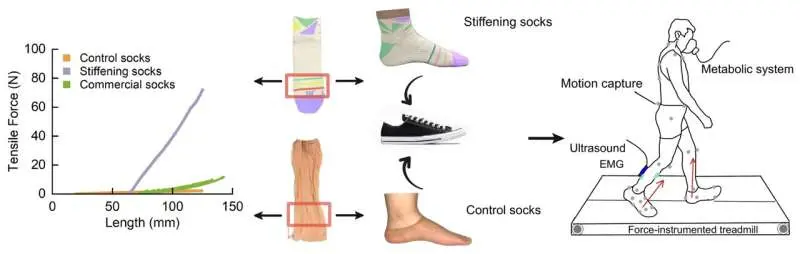
The socks feature tightly knitted bands around the ball of the foot. When someone stands or walks, they restrict the foot from spreading out or widening under pressure, a condition known as foot splay. This, in turn, increases arch stiffness. What the researchers didn't know, however, was whether this extra stiffness would actually conserve energy without interfering with the natural movement needed for push-off.
And the only really effective way to find out was to put them on some feet.
Putting socks through their paces
Beck and Tang recruited 12 healthy young adults who walked on a treadmill at ordinary walking speeds. Participants wore either the custom foot-stiffening socks or ordinary control socks that lacked the tight compression bands. As they walked, the researchers tracked oxygen use and carbon dioxide production to measure energy expenditure, while sensors in the treadmill and motion cameras checked how their stride changed.
The custom socks reduced the net energy cost of walking by an average of 2% compared with the flexible control socks. Ten of the 12 participants experienced a reduction in energy expenditure.
While this percentage might sound small, the researchers point out that it is comparable to the energy savings from removing 2 kilograms (4.4 pounds) of weight from around the waist.
More than just a pair of socks
Analysis of the sensor data revealed how the socks achieved this. The compression bands made the foot stiffer, allowing the calf muscles to contract more slowly and use less energy without disrupting natural push-off mechanics. "Foot-stiffening socks reduced whole-body metabolic rate by eliciting more economical ankle muscle contractions, not by reducing muscle mechanical work," wrote the study authors.
Beck and Tang suggest that this knit design could offer a low-cost, practical way to reduce the effort required for everyday walking, potentially helping people walk farther before tiring.
Beyond a practical garment, the scientists believe their work may help explain why our feet developed the way they have. "Here, our empirical findings support the claim that greater foot stiffness may have evolved to elicit more economical walking."
Written for you by our author Paul Arnold, edited by Lisa Lock, and fact-checked and reviewed by Robert Egan—this article is the result of careful human work. We rely on readers like you to keep independent science journalism alive. If this reporting matters to you, please consider a donation (especially monthly). You'll get an ad-free account as a thank-you.
Publication details
Hui Tang et al., Foot-stiffening socks reduce the metabolic cost of walking, Proceedings of the Royal Society B: Biological Sciences (2026). DOI: 10.1098/rspb.2026.1467
Who's behind this story?
Paul Arnold
BSc Biology from University of London. BBC documentary producer with world travel experience. Freelances from southern Spain. Full profile →
Lisa Lock
BA art history, MA material culture. Former museum editor, paramedic, and transplant coordinator. Editing for Science X since 2021. Full profile →
Robert Egan
Bachelor's in mathematical biology, Master's in creative writing. Well-traveled with unique perspectives on science and language. Full profile →
© 2026 Science X Network
Citation: Foot-stiffening socks could make walking less tiring (2026, November 4) retrieved 4 November 2026 from https://phys.org/news/2026-11-foot-stiffening-socks.html
This document is subject to copyright. Apart from any fair dealing for the purpose of private study or research, no part may be reproduced without the written permission. The content is provided for information purposes only.