



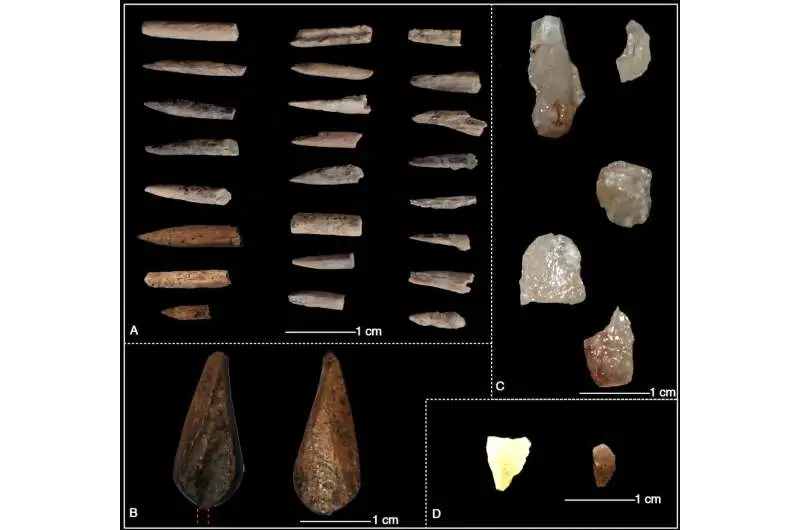
A study published in the Journal of Island and Coastal Archaeology has identified the earliest evidence of prehistoric occupation by island dwellers of northern Sri Lanka. Long thought to be unsuitable for human occupation due to its scarce stone resources and semi-arid landscape, the findings at Velanai Island challenge this long-held belief and offer insights into early raw-material exploitation, seafaring capabilities, and subsistence behavior.
Northern Sri Lanka and Velanai Island
The earliest evidence of human occupation in Sri Lanka can be dated back to around 25,000 years ago at sites like Pathirajawela. However, while there is much evidence of shell midden occupation in the wet southern regions of Sri Lanka, especially around 5,300 and 3,400 cal BP, similar occupations in the north of Sri Lanka are lacking.
It has long been assumed that the semi-arid landscape, scarce freshwater resources, lack of raw lithic material, and limited vegetation made the northern regions of Sri Lanka unfavorable for human occupation until the arrival of agro-pastoralists from India during the 5th century BCE.
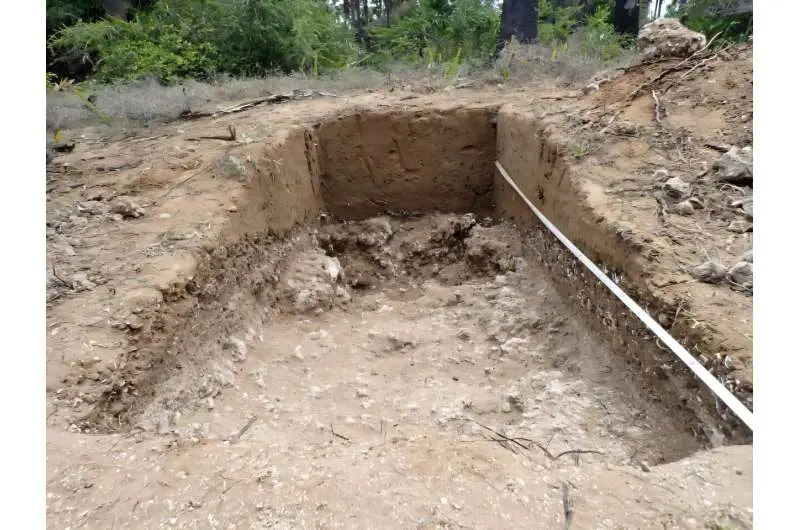
However, excavations at Velanai Island, located in the Jaffna Peninsula of northern Sri Lanka, have revealed an extensive shell midden with its earliest marine deposit dated to roughly 6300 to 5970 cal BP. In comparison, its earliest human occupation is dated to around 3460 cal BP, making it the earliest scientifically confirmed prehistoric occupation in northern Sri Lanka.
Subsistence, seafaring, and sea levels
Analysis of the shell midden reveals that the foragers of Velanai relied heavily on mollusks, especially Gafrarium pectinatum, which made up nearly 60% of the mollusk assemblage. Various other resources, including seabreams, deer, wild boar, dugongs, and dolphins supplemented this diet.
Examination of the shells in particular indicates a period (L4) of intensification during which foragers likely harvested mollusks so intensely that their overall size was reduced, or potentially reflects a local environmental shift.
Meanwhile, the presence of non-local quartz and chert flakes, which would have had to have been sourced nearly 60 km away on the mainland, indicated deliberate raw material transport and possibly short-distance seafaring capabilities, as Velanai is separated from the mainland by over 5 km of sea.
The findings mirror patterns seen in southern Sri Lanka's shell middens, which indicate flexible foraging strategies combining intensive shellfish gathering with some nearshore and terrestrial resource exploitation.
The findings indicate that the apparent gap in occupation between southern and northern Sri Lanka is likely due to preservational bias rather than habitat suitability, explained Dr. Thilanka Siriwardana, lead author of the study.
"During the Late Pleistocene, lower sea levels would have exposed extensive coastal plains. In semi-arid northern Sri Lanka, populations likely settled closer to these then-active shorelines. As sea levels rose during the Holocene, these landscapes were progressively submerged, effectively removing earlier sites from the visible archaeological record.
"What we see at Velanai, therefore, likely represents post-submergence settlement along newly established shorelines, rather than the initial phases of human occupation in the region."
Future research
Dr. Siriwardana continues explaining that there are several ways to approach this problem, including the study of uplifted coastal terrains, which are natural archives of ancient shorelines and may preserve signatures of past shell midden.
"Another approach is to examine inland archaeological sites for marine-derived materials, which can indicate past coastal reliance even if the original shoreline sites are no longer accessible," Dr. Siriwardana continued. The most challenging but critical approach would be to investigate submerged landscapes directly, especially in lagoons and low-energy coast environments, where evidence may be better preserved.
"At this stage, we do not plan to re-excavate the CB/Ex1 site unless new analytical techniques become available. Given the limited number of sites in this region, preservation and careful future use are priorities. Instead, our research is moving in several complementary directions," Dr. Siriwardana explained.
These directions include long-term ecological analysis using shell assemblages.
"As we already reported from Velanai and again observed at Punguduthivu, a gradual reduction in the size of Gafrarium pectinatum shells over time, from the 4th millennium BCE, is visible. This pattern may reflect increasing human exploitation and environmental pressure, offering a valuable proxy for understanding historical human–environment interactions in a historical ecological sense," Dr. Siriwardana elaborated.
According to Dr. Siriwardana, similar hunting pressures may also have been present in dugongs and rays, resulting in significant ecological impacts. But direct archaeological evidence of such exploitation is limited; further research may give insights into long-term resource use and intensification.
Written for you by our author Sandee Oster, edited by Sadie Harley, and fact-checked and reviewed by Robert Egan—this article is the result of careful human work. We rely on readers like you to keep independent science journalism alive. If this reporting matters to you, please consider a donation (especially monthly). You'll get an ad-free account as a thank-you.
More information
Thilanka M. Siriwardana et al, Coastal foragers beyond the mainland: Seafaring and early island settlement on Velanai, Jaffna, Sri Lanka, ca. 3460 cal BP, Journal of Island and Coastal Archaeology (2026). DOI: 10.1080/15564894.2026.2624853



© 2026 Science X Network
Citation: Northern Sri Lanka's oldest confirmed settlement reshapes what archaeologists thought about early island life (2026, May 8) retrieved 8 May 2026 from https://phys.org/news/2026-05-northern-sri-lanka-oldest-settlement.html
This document is subject to copyright. Apart from any fair dealing for the purpose of private study or research, no part may be reproduced without the written permission. The content is provided for information purposes only.