



Hong Kong authorities have announced detailed operational, transport and immigration arrangements ahead of the opening of the redeveloped Huanggang Port on 12 October 2026. The new port will begin operations at 6.30am, replacing passenger clearance services previously handled through the Lok Ma Chau Control Point. According to the official government announcement, multiple departments will coordinate crowd management, customs clearance and public transport operations to support a smooth transition between the two facilities.
Cross-department co-ordination for border operations
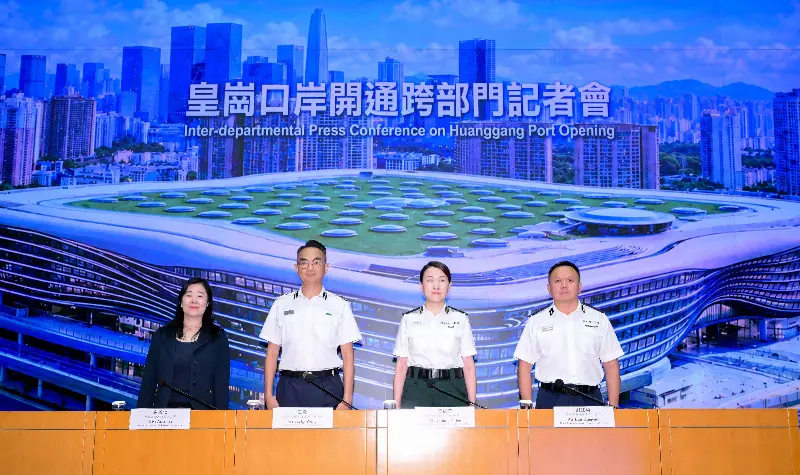
The Immigration Department, Customs and Excise Department, Transport Department and Hong Kong Police Force will jointly oversee the switchover process. Authorities said a joint command centre will be established to monitor passenger and vehicle flows in real time and coordinate with Shenzhen border authorities.
The Immigration Department said travellers arriving at either the Lok Ma Chau Control Point or the temporary Huanggang Port facilities in Shenzhen before 6.30am on 12 October would still be able to complete immigration procedures. During the initial operating period, the department expects increased traffic volumes around the new crossing and advised travellers to allow additional time for their journeys.
The new port introduces “collaborative inspection” automated channels and “joint one-stop” vehicle lanes designed to streamline border procedures. Drivers using the new vehicle lanes will complete customs and immigration processing through integrated information collection devices that capture travel documents, biometric information and body temperature data.
Transport services adjusted for opening day
The Transport Department has coordinated with public transport operators to revise service schedules during the overnight transition period. The final northbound “Yellow Bus” service from San Tin Public Transport Interchange to the original Huanggang Port will depart between 6.15am and 6.20am on 12 October.
From the opening of the new port, franchised bus and green minibus routes serving the crossing will begin operations earlier than usual to support the first wave of passengers. Authorities said standby vehicles would also be positioned at the new public transport interchange to manage demand.
The transport changes form part of wider infrastructure planning linked to Hong Kong’s Northern Metropolis strategy, including initiatives such as smart motorway planning for the Northern Metropolis and proposed logistics developments around border districts. The government is also consulting industry stakeholders on projects including the Hung Shui Kiu logistics cluster.
Passenger and vehicle clearance measures
The Customs and Excise Department said additional personnel would be deployed at both the new Huanggang Port and the Lok Ma Chau Control Point during the transition period. Officials will monitor the final inbound and outbound cross-boundary buses and private vehicles to ensure all clearance procedures are completed before the original facilities cease operation.
A “passenger-vehicle separation” arrangement will also apply at the new port. Passengers travelling in cross-boundary private cars must disembark at designated drop-off points and proceed through immigration halls on foot with their belongings, while drivers complete vehicle processing separately.
Authorities have encouraged eligible Hong Kong residents to enrol in advance for the “HK e-Channel” mobile application to use the collaborative inspection channels. Travellers were also reminded to carry valid travel documents meeting both Hong Kong and Mainland immigration requirements.
Traffic control and crowd management plans
The Hong Kong Police Force will implement crowd control and traffic diversion measures during the overnight switchover operation. Police officers will be deployed at the Lok Ma Chau Control Point, the San Tin Public Transport Interchange and the new Huanggang Port to manage passenger movements and maintain traffic flow.
Temporary vehicle holding areas may also be activated if traffic queues risk extending onto surrounding roads, including San Sham Road and San Tin Highway. Authorities said water-filled barriers would be installed at the entrance to the Lok Ma Chau Control Point once diversion measures begin.
The opening of the redeveloped port forms part of broader efforts to modernise cross-boundary infrastructure and improve connectivity between Hong Kong and Shenzhen. Recent transport initiatives include work on the Kai Tak smart transit project, which aims to strengthen urban mobility through digitally enabled transport systems.
This article is created with the assistance of OpenGov AI.