



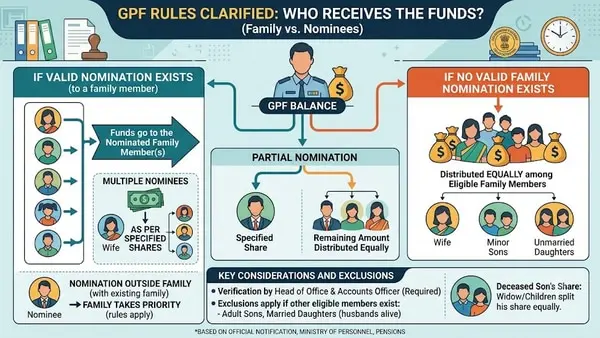
The central government has clarified who is entitled to the General Provident Fund (GPF) balance of a deceased government employee, settling long-standing doubts over whether the money should go to nominees or to eligible family members.
In an office memorandum dated 29 October, the Ministry of Personnel, Public Grievances and Pensions set out how GPF payments work when a serving employee dies. It covers deaths both before the balance becomes payable and after it becomes payable but before the amount is released. The memorandum also defines “family” and explains Rules 2 and 5 of the General Provident Fund (Central Services) Rules, 1960. The aim is to prevent prolonged legal disputes and ensure the proceeds reach the rightful nominees and family members.
Who gets the GPF money: Nominee or family?
If the employee has made a valid nomination in favour of a family member, the nominee receives the funds. Where there are multiple nominees, the amount is divided in the proportions specified in the nomination.
If there is no valid family nomination, or the nomination covers only part of the balance, the remaining amount is divided equally among eligible family members.
A nomination in favour of someone outside the family does not override the entitlement of eligible family members, if the employee leaves behind a family, subject to the rules.
The rules can be summarised as follows:
Note: The above-discussed cases are illustrative only. For complete details, refer to the official GPF terms and conditions.
Which family members are excluded from GPF payments?
Certain family members may be excluded from receiving a share of a deceased employee’s GPF balance under the first proviso to Rule 33(i)(b) of the General Provident Fund (Central Services) Rules, 1960. This includes:
- Sons who have attained majority.
- Sons of a deceased son who have attained majority.
- Married daughters whose husbands are alive.
- Married daughters of a deceased son whose husbands are alive.
However, this exclusion applies only if the deceased employee leaves behind at least one family member who does not fall into any of these four categories. Adult sons and the other specified relatives are therefore not automatically disqualified, and each case is decided on its facts.
The rules also provide that the widow or widows, along with the children of a deceased son, will collectively receive funds in equal shares, only in the proportion that the deceased son would have received had he survived the subscriber and been exempt from the exclusions applicable to adult sons.
This simply means, for example, that a GPF subscriber has a son, and the son dies before the subscriber; later, after the subscriber's demise, his son's widow or widows and children can receive the share he would have received in the same proportion as per the nomination if he had been alive. They must divide that share equally among themselves.
The Head of Office and Accounts Officer must carefully check and verify the subscriber’s GPF account and relevant service records, verify the validity of the nomination, and determine the eligible family members and their respective shares before clearing and authorising the final payment.
Being named as a nominee does not by itself establish entitlement to the GPF balance. The validity of the nomination, the subscriber’s family status and the provisions of Rule 33 together decide who receives the money.
Disclaimer: This article is based on the government’s office memorandum dated 29 October and the General Provident Fund (Central Services) Rules, 1960. It is for general information only and does not constitute legal advice. Readers should refer to the official notification and applicable rules for complete details.